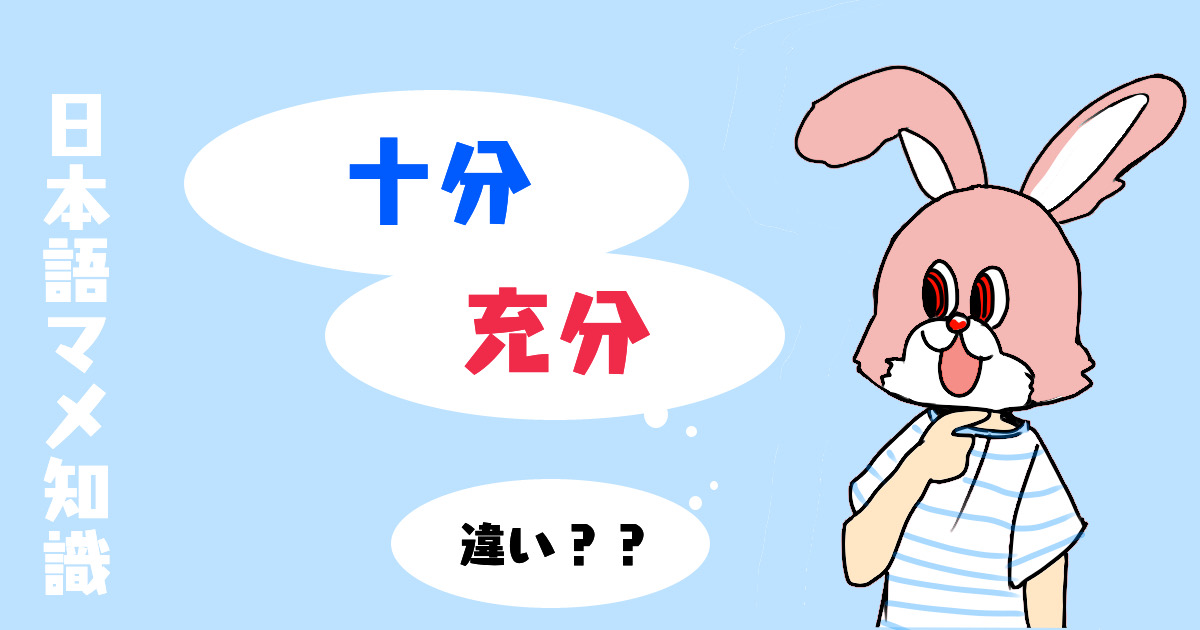

ここに、昨日の漢字テストがあります。「じゅうぶんに気をつける」の「じゅうぶん」の漢字を書きましょう、という問題です。Here’s yesterday’s kanji test. The question was: “Write the kanji for juubun ni ki o tsukeru (‘be careful enough’).”
僕は「十分」と書きましたね。I wrote 「十分」.
はい。ですが、隣の席の真っ青ウサギさんは「充分」と書いています。Right. But the student next to me, Blue Bunny, wrote 「充分」.
えっ。「十分気をつける・充分気をつける」どっちが正しいですか? Wait—so which is correct: 「十分気をつける」 or 「充分気をつける」?
どちらも正解です。Both are correct.
えええ!?どうしてですか!教科書には「十分」しか書いてなかったですよ! What?! But the textbook only had 「十分」!
まあまあ、時間は「十分」いえ「十二分」にありますので、落ち付いて説明していきましょう。Well, well, we have plenty—no, more than enough—time, so let’s go over it calmly.
「十分」と「充分」の意味・言い換え・英語
「十分(じゅうぶん)」という言葉を辞書で引いたり、パソコン変換しようとすると、「充分」も出てきます。どちらも不足がないという意味で、読み方も同じです。「じゃあどちらを使えばいいの!?」と思いますよね。まずは、「十分」と「充分」の意味や言い換え表現、英語、どんな気持ちで使用するのか、その使い方を見ていきましょう。
When you look up the word 「十分 (juubun)」 in a dictionary or try typing it on a computer, 「充分」 also appears. Both mean “enough” or “sufficient,” and they’re pronounced the same. So you might wonder, “Which one should I use!?” Let’s take a look at the meanings, synonyms, English equivalents, feelings behind each, and how they’re used.
「十分」の意味・言い換えは?公用文に使う?
- 数値的・物理的に満ち足りていること。Feelingsquantitatively or physically sufficient.
- 気持ちよりも事実が優先される。Used in focuses more on facts than.
- 公的文書に用いられる。Used in official documents or factual contexts.
- 言い換え:充分、存分、十二分、満足、たっぷり、十分量、たくさん、豊富、余裕、ゆとり、適当、満たした、完全、完璧
- 英語:plenty, sufficient, satisfactory, perfect
「十分な時間があったので、試験対策はバッチリだ。」We had plenty of time, so the exam prep went perfectly.
「君が十分成績を出してくれたから、助かったよ。」Thanks to your sufficient results, you really helped us.
「時間に十分余裕を持って行動するようにしましょう。」Let’s make sure to act with enough time to spare.
「ここからは危険です。十分に気をつけてくださいね。」It’s dangerous from here on—please be very careful.
「(何かを勧められて)あ、もう十分です(のでいりません)。」(When offered something) “Oh, that’s enough, thank you.”
【充分】の意味・言い換えは?公用文に使う?
- 精神的に満ち足りていること。Spiritually or emotionally fulfilled.
- 気持ちが充足している状態で用いる。Used when describing a feeling of satisfaction or emotional sufficiency.
- 公的文書には用いられない(日本国憲法除く)。Not used in official documents (except the Japanese Constitution).
- 言い換え:十分、満足、余裕、ゆとり、満ち足りた、充足
- 英語:sufficient, satisfactory
「お金に余裕があったので、充分な生活ができた。」Since I had enough money, I could live a comfortable and satisfying life.
「君がいればそれだけで充分さ。」As long as you’re here, that’s enough for me.
「十分」と「充分」の違い・使い分け・使い方
Now, which is correct below?
「充分満足しています。」
上の例ですが、どちらも正しいです。Both are correct.
ええ!?「満足」だから、気持ちの話ですよね?「十分満足」は間違いでは? What? Since it’s about feelings, shouldn’t it be ‘充分満足’? Isn’t ‘十分満足’ wrong?
皆さんもこのように思われたかもしれません。しかし、公的文書に【充分】が用いられないため、全て【十分】で表すこともあることを覚えておいてください。文部科学省用字用語例には「十分」のみが書かれているため、厳密には「充分」と書くべきところでも、「十分」と書いて良いのです。つまり、「充分満足だ」→「十分満足だ」でOK! Many people think that way. However, since 「充分」 isn’t used in official documents, everything is often written as 「十分」 instead. According to the Ministry of Education’s writing guidelines, only 「十分」 is listed, so even when 「充分」 might feel more fitting, writing 「十分」 is perfectly fine. So: 「充分満足だ」 → 「十分満足だ」 is OK!
私的文書でも「十分」と書けば、まず間違いがありません。逆に、公用文に携わる人は、【十分】で統一するため注意が必要ですね。Even in personal writing, using 「十分」 is never wrong. On the other hand, those handling official documents should always use 「十分」 consistently.
どっちが正しい?「十分な時間」「充分な睡眠」
それでは、次の例文はどちらが正しいか比べてみましょう。Let’s compare the following examples to see which form is correct.
「充分な時間があります。」→△
この場合、「時間」という数値的なものがあるため、厳密にいえば【十分】が正解。しかし、その時間が、精神的に満たされる充実の時間を意味しているのであれば、【充分】も間違いではありません。ただし、この場合は「充分な時間があります」という言い方にはなりにくく、「充分な時間を過ごした」などの使い方が自然です。Here, 時間 (time) is a measurable, numerical concept, so strictly speaking, 「十分」 is correct. However, if the phrase refers to a spiritually fulfilling or emotionally rich time, then 「充分」 isn’t wrong either. That said, you would naturally say 「充分な時間を過ごした」 (“I spent a fulfilling time”) rather than 「充分な時間があります」.
「充分な睡眠」→OK
一方、こちらはどちらも正解ですが、意味に違いが考えられます。「十分な睡眠」とは、睡眠時間が十分であるということ。「充分な睡眠」とは、その人が精神的に満たされるような睡眠だったということです。穏やかで質が良く、朝スッキリ目覚められた…そんな睡眠は「充分」と言えますよね。Both are correct, but their meanings differ slightly:「十分な睡眠」 means a sufficient amount of sleep—enough hours.「充分な睡眠」 means satisfying sleep—mentally and physically refreshing. If you woke up calm and well-rested, that would be 「充分な睡眠」.
どっちがビジネスで正しい?十分気をつけますvs充分気をつけます
さて、ビジネスメールなどで「十分気をつけます」と「充分気をつけます」どちらが正しいか迷ったことがある人も多いでしょう。前述した通りの理由で、ビジネスでも敬語でもどちらも正解。ですが、受取り手はそれぞれ異なる印象を持つかもしれません。「十分気をつけます」と「充分気をつけます」の印象の違いを見ていきましょう。In business emails, many people wonder which to use. As mentioned earlier, both are technically correct in everyday or polite Japanese.
However, the impression they give can differ slightly.
②「充分気をつけます。」
①「十分」の場合、しっかり謝罪の意図が伝わります。しかし、パッと見たときに時間の「(時間の)10分」に見えるため、「充分」を使うという人もいます。それでは、②「充分」は、どうでしょうか。こちらも、謝罪の意図がよく伝わります。「十分」よりやや気持ちを優先したフランクなニュアンスになりますが、多くの人はその違いまで意識することはないでしょう。①「十分気を付けます。」Conveys a clear, formal sense of apology or caution. Some people avoid it because at first glance “十分” might be mistaken for “10 minutes.” ②「充分気をつけます。」Also expresses sincere intent. Feels a bit softer or more emotional, but most readers won’t notice much difference.
くどいようですが、「充分」は公文書では使えません。Still, to repeat an important point:「充分」 should not be used in official documents.
「十分」の言い換え「存分」の違いとは
「十分」と同じく《満ち足りている様子》を表す類義語に「存分」という言葉もあります。「存分」の意味と使い方、英語、言い換え表現、「十分」と「存分」の違いについてもご説明していきましょう。
Just like 「十分」, the word 「存分」 also expresses a sense of being fulfilled or satisfied. Let’s look at its meaning, English equivalents, synonyms, and how it differs from 「十分」.
「存分」の意味・言い換え・英語は?
- 思い通りに満ち足りた様子。Feeling fully satisfied or doing something as much as one wishes.
- 存分の「存」は《思う・考える》という意味。The character 「存」 originally means “to think” or “to feel,” emphasizing the emotional aspect of satisfaction.
- 言い換え:十分、十二分、心ゆくまで、気の済むまで、思う存分、とことん、徹底的に、思い切り
- 英語:fully, thoroughly, to one’s heart’s content
「狭い部屋ですが、存分にくつろいでくださいね。」The room is small, but please relax to your heart’s content.
「新しいレストランの味を存分に楽しんだ。」We fully enjoyed the flavors at the new restaurant.
「十分」と「存分」違いと使い分け
先で述べたように、「存分」の存分の「存」は《思う・考える》という意味。「十分」と「存分」の違いは、自分の気持ちに対する満足感の違いと言えます。「十分」 emphasizes quantity or objective sufficiency—having enough of something. 「存分」 emphasizes feeling and personal satisfaction—doing or enjoying something freely and completely.
②「存分に楽しんだ。」
①「十分に楽しむ」というと、不足・欠点なく10点満点で楽しむということ。②「存分に楽しむ」は、自分の思うまま、思い通りに楽しむということです。In short, 「十分」 = enough, while 「存分」 = to your heart’s content.
「十分」の言い換え「十二分」の違いとは
「十分」の言い換え表現に、「十二分(じゅうにぶん)」があります。「十分」よりもさらに満ち足りている様子を表します。「十分」と「十二分」違いと使い分けを詳しく見ていきましょう。
Among the synonyms for 「十分」, there is 「十二分(juunibun)」, which expresses an even greater sense of satisfaction or sufficiency. Let’s look at its meaning, English equivalents, and how it differs from 「十分」.
「十二分」の意味・言い換え・英語は?
- 余裕があるほど満足していること。Being more than satisfied—having ample or abundant sufficiency, even beyond what’s needed.
- これ以上ないほど最高の満足度やゆとりを表す。It conveys the highest level of satisfaction or completeness.
- 言い換え:十分、存分、ものすごく、とことん、徹底的に、これ以上ないほど
- 英語:more than enough, to one’s heart’s content
「君の作品、十二分に楽しませてもらったよ。」I more than enjoyed your work—it was truly wonderful.
「今日が最後の試験です。十二分に力を発揮してください。」Today is the final exam. Please give it your very best effort.
「十分」と「十二分」違いと使い分け
「十分」と「存分」違いは、満足度の度合い。「十二分に楽しんだ」というと、これ以上ないくらい楽しんだ!という意味です。「十分」よりも満足度が高く、これ以上はない最高の満足度で使用します。The difference lies in the degree of satisfaction.「十分」 means enough—no lack, sufficient.「十二分」 means more than enough—completely fulfilled, to the utmost. When you say 「十二分に楽しんだ」, it means you enjoyed it to the fullest, as much as possible.
満足度は「十二分」>>>「十分」です。「十二分に力を発揮した」も、よく使います。In terms of satisfaction level: 「十二分」 >>> 「十分」Expressions like 「十二分に力を発揮した」 (“gave it your all”) are also very common.
まとめ
- 十分と充分の違い
「十分」は数値的、物理的満足。
「充分」は精神的満足。
「十分」は公用文で使用される。 - 十分と存分の違い
「十分」は不足・欠点なくということ。
「存分」は思い通り満足 - 十分と十二分の違い
「十二分」>>>「十分」
前回記事:【違う】と【異なる】の違いとは?
次回記事:【標準語】と【共通語】の違いとは?


コメント