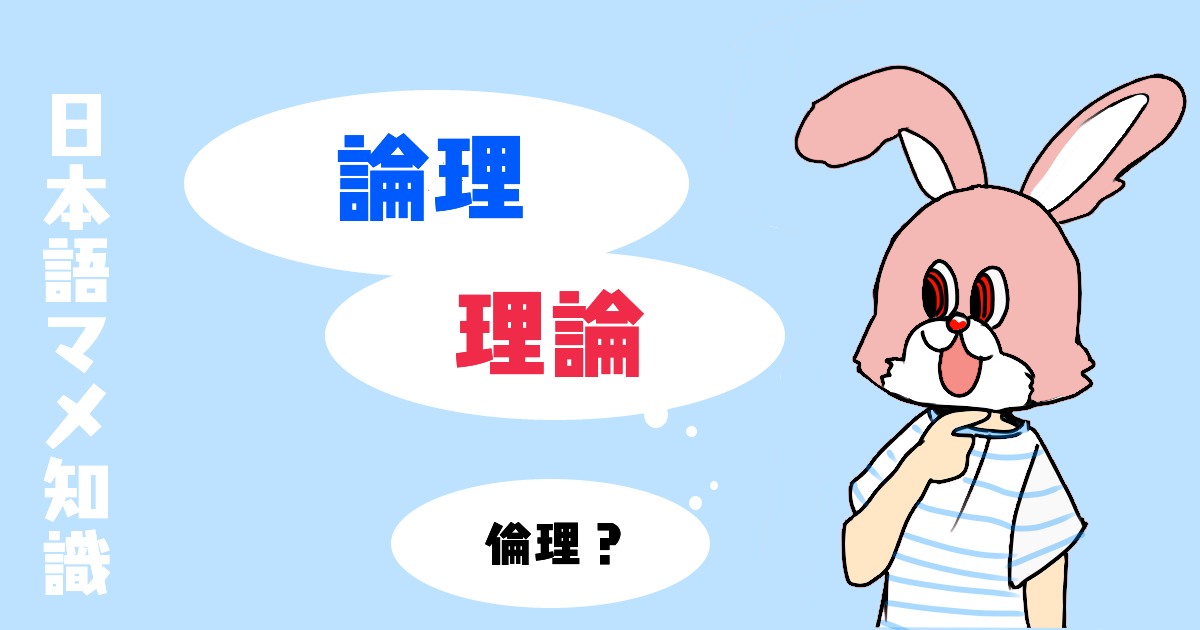

先生はミステリお好きですか? Do you like mysteries, Sensei?

はい、自前の理論から論理を組み立てて犯人を倫理的に追い詰めていくタイプのミステリが好きですね。Yes, I like the kind where the detective builds logic from their own theory and corners the culprit ethically.
え…コワ…。そういえば、理論と論理って違いがあるのでしょうか? Uh… that’s kind of scary. By the way, is there a difference between riron and ronri?
実はありますよ。違いを知らない人も多いですが、「セオリー」と「ロジック」というと分かりやすいでしょうか? Actually, there is. Many people don’t know it, but it’s easier to see if we say “theory” and “logic” in English.
いえ!カタカナ語になってより分かりにくいです! No! That just makes it even more confusing!
…ちなみに、倫理と論理の違いも説明できますか? …Can you also explain the difference between rinri and ronri?
ひー! Yikes!
論理と倫理は似た言葉ですが、明確な違いがあります。ここでは、論理と倫理、理論の違いと関係を例文や英語からわかりやすく解説していきます。倫理的とは何か、論理的とは何か、意味や読み方、論理学と倫理学・倫理観と論理感の違いなども見ていきましょう。
Logic and ethics sound similar, but they’re clearly different. Here, let’s break down the differences and relationships among logic, ethics, and theory with examples and English terms. We’ll also look at what “ethical” and “logical” mean, how they’re read, and how logic and ethics differ as fields and perspectives.
論理の意味とは?倫理とは?理論とは?
「論理」と「倫理」そして「理論」。字面はかなり似ていますが、それぞれどのような意味なのでしょうか。まずは、論理とは、倫理とは、理論とは何なのか、その意味と読み方、英語などを見ていきましょう。
“ronri,” “rinri,” and “riron” — they look quite similar in writing, but what do they each mean? Let’s start by looking at what they are — their meanings, pronunciations, and English equivalents.
「論理」の意味と読み方・英語
- 思考や話を進めていくための道筋。The path or structure of thought and reasoning.
- 読み方:ろんり
- 英語言い換え:logic
「論理的な思考力を育てるために、本は必要不可欠です。」Books are essential for developing logical thinking skills.
「論理を組み立てていけば、この件は難なく解決する。」If you build up the logic, this issue will be easily solved.
論理とは、思考や議論を進めるため具体的な結論に至るまでの道筋のことです。「私は目的地に向かっている」⇒「しかし目的地が見つからないし、ここがどこかもよく分からない」⇒「私は迷子である」といった形で、考えが一貫しているかを判断する基準になります。“Ronri” refers to the reasoning process — the path that leads your thoughts or discussions to a concrete conclusion. For example: “I’m heading toward my destination.”⇒ “But I can’t find it, and I’m not sure where I am.”⇒ “Therefore, I’m lost.”
⇒でつながっていく道筋が「論理」です。The chain of reasoning connected by “⇒” — that’s logic.
「倫理」の意味と読み方・英語
- 人間生活の秩序の中で行うべき規範の筋道。The moral standards or principles that guide human behavior within the order of society.
- 読み方:りんり
- 英語:ethics,morals(日本語でいうモラル)
「彼の行動は倫理に反している。」His actions go against ethics.
「キリスト教徒と仏教徒の倫理観は違うだろう。」Christians and Buddhists probably have different ethical views.
倫理とは、人間社会における道徳的な規範やモラルを指します。類語としては、「モラル」「道徳」などがあります。“Rinri” refers to the moral codes or standards that govern behavior in human society. Similar words include morals and morality.
倫理は、その社会・国・宗教などによって異なることが多いです。Ethical standards often vary depending on the society, country, or religion.
ゴミのポイ捨ては日本の倫理観では完全にアウトなのでやめましょう! Littering is completely against Japanese ethics — so don’t do it!
「理論」の意味と読み方・英語
- 論理的に説明するための考え方。A way of thinking used to explain something logically.
- 事象を統一的に説明するため組み立てられた知識体系。A systematic framework of ideas built to explain phenomena consistently or to logically explain something.
- 読み方:りろん
- 英語:theory
「この事象は、物理法則に理論づけられる。」This phenomenon can be explained by physical theory.
「彼は自身の理論を発表した。」He presented his own theory.
理論とは、特定の結果を導くための体系的な考え方。事象を統一的に説明するために構築された知識体系を指します。“Riron” is a structured system of ideas designed to lead to specific conclusions or to explain various events in a unified way.
よく聞く「恋愛の理論(セオリー)」とは、「好きな相手にアプローチ」→「恋愛成就」という論理(道筋)を作るためのものです。When people talk about a “theory of love,” it means a framework —like “approach the person you like”→ “achieve a relationship.”
つまり、「相手に意識させる」「相手の好きなものを知る」など具体的なものが「理論」ということですね! In other words, concrete ideas such as “make the person notice you” or “learn what they like” are part of what we call theory.
論理と倫理と理論の違いとは?
「論理」と「倫理」「理論」の意味や例文・英語を確認してきました。それでは、それぞれどんな違いがあるのでしょうか。字面が似ている「論理と倫理の違い」「論理と理論の違い」をわかりやすく見ていきましょう。
We’ve looked at the meanings, examples, and English equivalents of logic (論理), ethics (倫理), and theory (理論). Now, let’s see how they differ. The words look similar, but their meanings are quite distinct.
論理と理論の違いをわかりやすく
殺人事件が起こりました。前人未到の難事件ですが、幸か不幸かその場には名探偵の姿が…。名探偵は持ち前の「理論」から「論理」を組み立てて真相を探ります。この時、順番的には「理論」→「論理」です。では、探偵が何を言ったのか、例文から見ていきましょう。A murder case has occurred — a seemingly unsolvable one. Fortunately (or unfortunately), a brilliant detective is on the scene. Using his “theory,” he constructs “logic” to uncover the truth.
In this case, the order is theory → logic. Let’s look at what he says.
論理:「これらの情報から考えるに…犯人は、あの人しかいない!」From this information… the culprit can only be that person!
「理論」は、解剖学や物理学など、探偵の持つ知識。「論理」は、それらのヒントから犯人を探す道筋です。Here, theory refers to the detective’s knowledge — anatomy, physics, forensics, etc. Logic is the reasoning path he follows using those clues to find the culprit.
論理と倫理の違いをわかりやすく
引き続き、探偵の例で見ていきましょう。探偵は論理を組み立てて、真相を見つけました。そして、指摘された犯人はその場で泣き崩れます。「あいつが悪いんだ!あいつが…俺の妹の命を奪ったんだ…!」よくある犯人も被害者ってやつです。しかし、殺人は殺人。この正義感あふれる探偵は、犯人にこう言いました。Let’s continue with the detective story. The detective pieces together the logic and discovers the truth. The accused breaks down in tears: “It’s his fault! He’s the one who killed my sister!” — a classic “the culprit was also a victim” situation. But murder is still murder. The righteous detective says:
人を殺した犯人の行動は、倫理的ではありません。「論理」と「倫理」は字面はよく似ていますが、意味は全く異なります。The murderer’s actions are unethical. Although logic (論理) and ethics (倫理) look similar, their meanings are completely different.
論理的と倫理的・論理学と倫理学・倫理観と論理感の違い
さて、これまで「論理」と「倫理」と「理論」について、違いや意味を見てきました。それでは、論理的と倫理的、論理学と倫理学、倫理観と論理感の違いはどのようなものなのでしょうか。
We’ve now explored the meanings and differences among logic (論理), ethics (倫理), and theory (理論). Next, let’s look at the differences between logical and ethical, logic and ethics as academic fields, and logical sense and moral sense.
論理的と倫理的の違い
「論理」と「倫理」は全く異なる意味であることは、もうお分かりかと思います。「論理的」「倫理的」は、それぞれ「論理」と「倫理」の形容詞(形容動詞)の形です。You already know that logic and ethics mean completely different things. Their adjective forms — logical (論理的) and ethical (倫理的) — also reflect that difference.
倫理的:人道的、社会通念上のルールに沿っている様子。Describes behavior that follows moral or social standards; humane or socially acceptable.
論理学と倫理学の違い
「論理学」と「倫理学」は、どちらも哲学の分野です。Both logic and ethics are branches of philosophy, but their focus is different.
倫理学:「道徳的・善悪の原則」を研究する。The study of moral principles — what is right or wrong and how humans should act.
論理学の目的は、推論形式を知ること。研究対象は、数学や言語学、法学に基づく推論法則や構造原理などです。
対して、倫理学の目的は、人がどのように行動すべきか、善悪とは何かを知ること。研究対象は、道徳的な規範や価値観、社会のルール、人と人との関わり方などです。
論理感と倫理観の違い
「論理感」と「倫理観」は、感覚や見方を表しています。These two refer to personal awareness or perspective.
倫理観:人として、社会の一員として守るべき道徳的な基準。A person’s sense of morality — the ethical standards they believe should be upheld as a member of society.
まとめ
- 論理と理論の違い
「論理」とは、議論を進めるための道筋。
「理論」とは、論理的に説明するための考え方。 - 倫理と論理の違い
「倫理」とは、道徳やモラル。
「論理」と意味は全く異なる。 - 論理的と倫理的の違い
論理的:考える道筋がしっかりしている様子。
倫理的:人道的、社会通念上のルールに則った様子。 - 論理学と倫理学の違い
論理学:「正しい推論の方法」を研究する。
倫理学:「道徳的・善悪の原則」を研究する。 - 倫理観と論理感の違い
論理感: 筋道を立てて理解する能力や感覚。
倫理観:人として、社会の一員として守るべき道徳的な基準。
これらの違いをわかりやすく理解することで、日常生活や仕事において、より論理的かつ倫理的に対応することができるようになりますね。
前回記事:【認識】と【認知】の違いとは?
次回記事:【倫理】と【道徳】の違いとは?


コメント